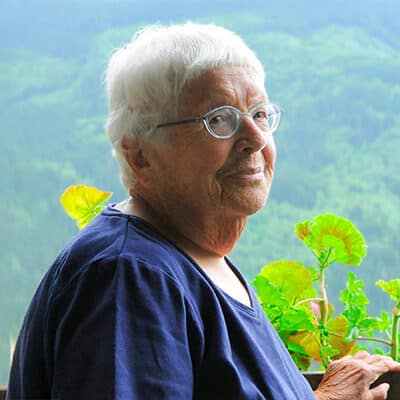
She has now arrived. Dr. Félicie Affolter, teacher, scientist, researcher, passed away on November 5, 2024, at the age of 98.
With an integer and singular character, she searched relentlessly, always going to the heart of matters. She didn't accept easy, quick answers. Imprecise observations or hasty interpretations displeased her. On the other hand, she could rejoice like a child upon noticing progress, whether in children or adults treated according to her model of felt-interaction therapy. The same was true when she struggled to precisely formulate a situation. She would then exclaim, «This is fantastic!» she would smile, and her face would light up full of gratitude and curiosity. This spark accompanied her throughout her life.
Even though she often showed impatience, she displayed infinite patience with the people to whom she had dedicated her entire life, people with perceptual challenges. However, with remarks such as «this child doesn't want to, they don't feel like it…,» the participants in her courses could literally incur her wrath. Until the end of her life, she persistently sought the reasons for the difficulties encountered in a particular situation. It was not uncommon for this to result in a new concept that she would integrate at the end of a week of classes in her legendary closing seminar.
«If I had had the makings for it, I would have become a women's rights activist,» she said in an interview in 2014. She would have had the makings for it, but she had other priorities. As a woman of her generation, she always had to fight to be recognized, first as a scientist and then for her discoveries. Throughout her life, this recognition was mainly granted to her abroad. In 1994, Félicie Affolter was elected «Person of the Year in Infant Studies» by Michigan State University in East Lansing and was simultaneously awarded a mandate to give lectures and various seminars. In 2008, the Global Programs and Strategy Alliance (GPS Alliance) and the University of Minnesota Alumni Association (UMAA) at the University of Minnesota awarded her the «Distinguished Leadership Award for Internationals» for her life's work.
In the United States, she received the space and opportunity to pursue research in the field of perception, which was more important to her than any honors. She directly integrated the results of her research stays into her work in Switzerland and neighboring countries. Tirelessly, she traveled from one course venue to another and trained generations of professionals in the practice of the Affolter® model.
Over the years, this circle has given rise to a group of teachers who have continued to disseminate the model. In April 2024, Félicie Affolter again participated in the APW meeting of these teachers in Disentis and spent the day discussing the model and reconnecting with many close friends.
When she was no longer able to teach her courses with her longtime research partner, Dr. Walter Bischofberger, due to age-related issues, she nevertheless continued to work behind the scenes. At the end of each week of classes, she would weave together the threads spun by the teachers into a solid network.
Even after the death of Dr. Walter Bischofberger in 2020, she continued her research work and collaborated closely with other companions on new publications until the end of her life.
For many years, the two institutions that she founded in Saint-Gall, the special school for children suffering from perception problems and the center for perception problems (the current fondation wahrnehmung.ch) have been the point of focus for her work. She assembled a group of dedicated collaborators who supported her in her research. This is also where she found the opportunity to put into practice her model of ’apprenticeship in everyday life«, as she called it, not only for patients but also for staff. This is also how she wrote Perception, Reality and Language (Etoy, L'Espérance, 1991), a work that will probably always be associated with her name in the specialized fields. Le Dr. E. E. Kobi (Bâle) wrote on this subject in his critique : » Un livre merveilleux par son contenu, son matériel, son écriture et sa présentation, qui est tout à fait propice à ramener dans la réalité de la vie de tous les jours au minimis une partie de la psychologie de l'enfant, longtemps desséchée par les statistiques et une frénésie de fait et à la rapprocher ainsi de la pédagogie curative «.