
Swiss franc 25,00
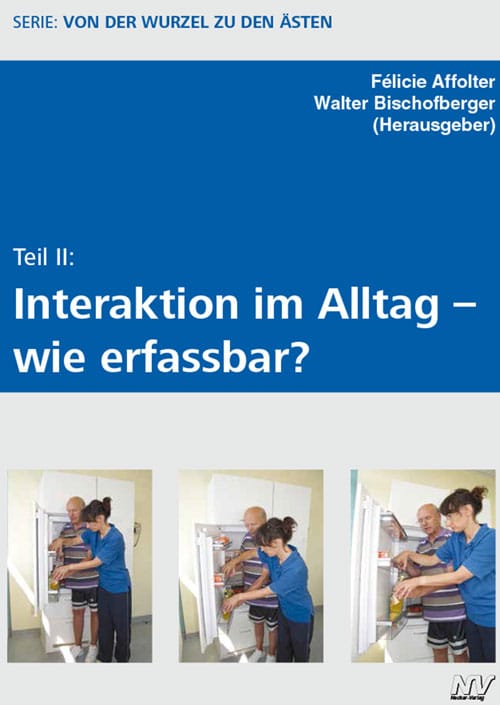
This book from the „From Root to Branches“ series shows how interaction becomes observable in everyday life – and how tactile information gains central importance in the Affolter Model® for therapeutic success and everyday competence. A valuable foundation for everyone working with patients with brain damage.
Key points at a glance
For several decades, the „Root Model of Felt Interaction“ has been applied in educational and clinical settings. The series FROM THE ROOT TO THE BRANCHES conveys important aspects that have been developed through further research work from the problem area of the transition „from the root to the branches.“.
But how can interaction in everyday life be captured?
In a typical patient assessment, various services are evaluated, but unfortunately, neither corresponding situations nor information are listed. For example, attention is assessed as if it were something absolute, even primary. There are research findings which, in contrast, view attention as something secondary and dependent on information and understanding.
Based on the study described in the book, the effectiveness of the Affolter Model is confirmed:
The selected observable behavioral changes are used to assess the difficulties as well as the existing achievements of brain-damaged patients in everyday life. This confirms developmental psychological findings on the importance of perceived interaction.
The benefits of interaction are dependent on information.
Tactile information is more important for everyday interaction than visual or auditory information.
What does this mean for practical work:
Brain-damaged patients fail in everyday interactions, daily tasks, social services, and verbal communication. These deficits are SECONDARY. They are caused by PRIMARY deficits, by failures in brain functions due to the brain damage. Therapy must address these, not the secondary ones. It can be expected that as primary functions improve, the secondary effects will gradually disappear. Thus, in our development process, how does a child acquire brain organization: through perceived interaction.
The book mentions examples that illustrate the importance of tactile information. The importance of applying the findings to the patients' performance dependency on information is also supported by some examples.
| Release date | 21.06.2022 |
|---|---|
| Publisher | Neckar-Verlag GmbH |
| Author(s) | Félicie Affolter and Walter Bischofberger (Editors) |
| ISBN | 978-3-7883-1227-5 |
| Format | 16.8 cm x 23.9 cm |
| Scope | 138 pages |
| Note | The representation is for illustrative purposes only. |
| Shipping | Save on shipping and customs costs: For orders from abroad, we recommend purchasing products from Neckar-Verlag directly or from a local bookstore. Neckar-Verlag: https://neckar-verlag.de/ |

Order cheaper